
Source: Classic’s birthday: an ear for the moderns – what really happened
Classic’s birthday: an ear for the moderns – what really happened
In an otherwise excellent article on the birth of Classic FM for The Spectator, my fellow Radio 3 presenter Petroc Trelawny – previously a colleague on Classic – states that when talking repertoire Classic’s powerhouse founder Michael Bukht insisted on ‘nothing you’d want to switch off’. Mozart was king, Beethoven, Brahms, Dvorak — yes, please. Bartok, Stravinsky and Britten were to be treated with suspicion. And absolutely nothing contemporary, thanks very much.’
Well that wasn’t quite the case, at least not in practice; in fact, in those days all the major Classic FM hits were contemporary, and never more so than with the very first, Henryk Gorécki’s Third Symphony which swept the nation more potently than any large-scale contemporary piece before or since. And this is how it happened. From the first week of Cfm’s existence I co-hosted a show called Classic Verdict with a mate, the much missed Keith Shadwick (who tragically died back in 2008). Every week we’d choose a ‘Sure Shot’ which Paul Gambaccini picked up the following day (on his Saturday Show). First up was Gorécki 3, and that was the very first piece that marked the station out as bringing the world of great music into the nation’s consciousness. Much as I’m devoted to Radio 3, they had never managed it, and neither had any other radio station. But the combination of new-born Classic and Gorécki made people realise how a contemporary symphony could be beautiful, original, relevant and in a sense life-changing. The proof of Gorécki’s integrity, if such were needed, is in the nature of his Fourth – a different beast entirely. Not for him a profitable bandwagon.
There’s another twist to this tale. A month before Classic launched Johnny Black had asked me to step into his place on Frank Bough’s LBC show, bring along a trio of classics to review. That same Gorécki recording (Dawn Upshaw, London Sinfonietta/David Zinman, Nonesuch) had just landed on my mat and I took it along. As I left the building, a receptionist rushed up to me and asked, ‘what was that CD just played? … our phone lines are jammed with people wanting to know’! So it was evidently the right piece at the right time.
Beyond Gorécki came Gavin Bryars’ Jesus Blood Never Failed Me Yet (Philips/Decca) and Officium with saxophonist Jan Garbarek and the Hilliard Ensemble (ECM), both of them sure shots that ‘shot’ right to the top of the charts. Among other impactful choices were De Stilj by Andriessen, though Bukht balked at its aggression. And yet he had a broader musical mind than many people think – he allowed me a series of ‘Contemporary and Classics’ and an historical series ‘Our Musical Yesterdays’. So, Relaxing wasn’t always the main agenda! Comments please.
Bach before Gould: Gieseking’s your man
Recorded in 1950, Walter Gieseking’s Bach series for Saarbrücken Radio promotes a lightness of touch, elegance and emotional engagement that anticipated Glenn Gould’s epoch-making Goldberg Variations of 1955 (Sony). Deutsche Grammophon have just released a 7-cd set (479 7362) that covers the whole of the Well-tempered Clavier, the Six Partitas and French Ouverture, the Italian Concerto and Chromatic Fantasia and Fugue, the Inventions and Sinfonias and other works, adding the Schumann Concerto in a wartime Berlin Philharmonic recording under Wilhelm Furtwängler
The nimble, deftly lilting ‘scherzo’ from the Third Partita in A minor BWV 827 should give you a good idea of what to expect
Mravinsky’s Sleeping Beauty: a minor miracle
The Pas de Quatre, the line utterly seamless, the rise and fall of it, the Leningrad strings in April 1948 the equal of any anywhere
From Volume 3 of Hanssler Profil’s ‘Yevgeny Mravinsky Edition’ (6cd – PH17019), and the best by far.
the 20th Century’s most thrilling musical moment?
[/audio]The moment in Bartók’s Miraculous Mandarin ballet suite when the Mandarin, hopelessly attracted to a hapless beauty forced to lure men in a thug’s den, is chased by the thugs prior to his murder. Little sign here that the Mandarin will only be able to die when the girl offers herself to him – which eventually she does. Not so much a case of sex and violence as redeeming compassion.
Essa-Pekka Salonen conducts the Los Angeles Phil, newly reissued in DG’s 40-cd “111” The Conductors – Legendary Recordings (479 7477)
To stop you in your tracks …
- a recorded fragment that’ll take your breath away
- today Joseph Schmidt sings Una furtiva lagrima from Donizetti’s L’elisir d’amore … a the voice pure velvet, the technique seemingly effortless
- the year 1931
- Selmer Meyrowitz conducts members of the Berlin State Opera Orchestra
- from Telefunken 2cd 0927 42665 2
Two great pianists from Sony’s back catalogue celebrated: Rudolf Serkin (Sony 88985404072,75 cds) and Robert Casadesus (Scribendum SC506, 30cds)
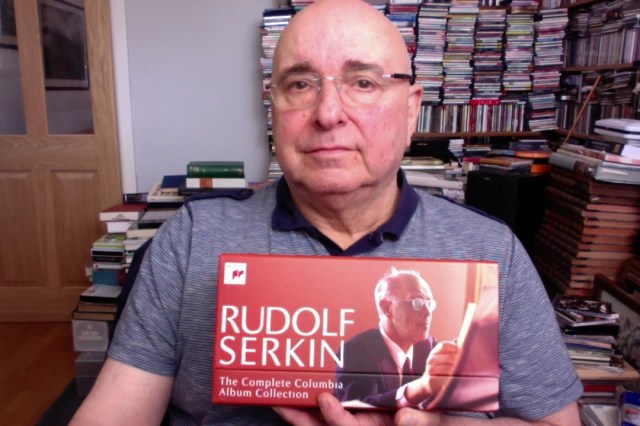 Years ago these two were the regular in-house players for Sony’s classical repertoire, with the odd foray backwards to Bach (both recorded the ‘Italian’ Concerto) or forwards to Bartók (the First Concerto with Serkin and Szell, the Sonata for two pianos and percussion with Robert and Gaby Casadesus). The principal difference between the two sets, discographically speaking, is that while Sony include absolutely everything that Serkin recorded for Sony (not least, in terms of concertos, four Brahms B flats and four Beethoven G majors), Scribendum select just one version of a particular work – the Ravel Concerto for the left hand being a fair case in points, also Beethoven violin sonatas with Zino Francescatti. Then again they also include material that isn’t part of Sony’s legacy, including a magnificent French Brahms B flat under Carl Schuricht, complete with wobbly opening horn solo and some ham-fisted chords – but the power of it, the cutting staccatos, expressive flexibility (from both pianist and conductor), the epic sweep of the performance: wonderful! Serkin with Eugene Ormandy (they collaborate on no less than three recordings of the work) is scarcely less imposing, especially the version from 1956. Stylistically, Serkin’s your man for subtle asides, even though occasionally prone to coarseness while Casadesus favours crisp articulation, that crispness sometimes suggestive of a frosty ‘edge’, and a propulsive rhythmic attack. Comparing the two in various Mozart concertos spins a telling tale. I’d value any comments here on the board.
Best, Rob.
 robccowan